 Join Potato Plus

Krampus folklore · with sources
Who is Krampus?
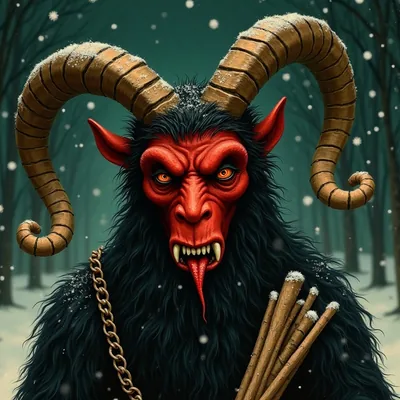
Krampus is a horned, shaggy, devil-like figure from Alpine folklore who goes along with St. Nicholas in early December: the saint rewards good children, and Krampus deals with the naughty ones, with a birch switch, rattling chains and a basket on his back to carry them off. He comes out on Krampusnacht, December 5, the eve of St. Nicholas Day, and in Austria, Bavaria and South Tyrol hundreds of masked Krampuses still run through the streets every year.
Where Krampus comes from
History.com says Krampus “comes from folklore in Austria's Alpine region”, and today he is found right across the Eastern Alps: Austria, southern Bavaria, South Tyrol and Trentino, and with local names in Slovenia (the parkelj), Hungary, Croatia, Slovakia and Czechia. Some writers think he is older than Christianity; nobody knows for sure. His name is usually traced to the German Krampen, “claw”. A 1912 study of Christmas customs already describes him in Lower Austria following St. Nicholas, and in Tyrol as a shaggy monster with horns, a long red tongue and “chains that clank as he moves”.
What Krampus carries
A Krampus costume is a fur suit, usually goat or sheep skin, with heavy cowbells on a wide leather belt and a hand-carved wooden mask, often a work of art in its own right. He carries a birch switch (the Rute), sometimes a chain, and on his back a basket, the Butte, in which naughty children are said to be carried off. English-language stories usually give him a sack instead. Good children, we are assured, have nothing to worry about.
Krampusnacht and the Krampus runs
Krampus Night is December 5, the night before the Feast of St. Nicholas (see When is Krampusnacht?). Towns hold Krampus runs, Krampusläufe, from late November into December: SalzburgerLand says the run in St. Johann im Pongau has more than a thousand Krampuses. In the Gastein valley the older form survives, with groups of St. Nicholas and his Krampuses going house to house on December 5 and 6. The dates for 2026, from Salzburg to New Orleans, are in our Krampus events guide.
Greetings from Krampus: the postcards
Europeans have sent Krampus cards, Krampuskarten, since the 19th century, often headed “Gruß vom Krampus”, “Greetings from Krampus”. History.com links them to the postcard boom in Germany and Austria in the 1890s; they show him stuffing children into his basket or leading them off in chains, sometimes flirting with grown-ups instead.
The ban, and the comeback
The usual account is that Austria's Dollfuss government banned the custom in the 1930s; a New York Times headline of December 1934 read “Krampus Disliked in Fascist Austria”, and pamphlets calling him an evil man were still handed out in the 1950s. National Geographic tells it a little differently, and sources disagree on how far any ban was enforced. Either way, he came back. Monte Beauchamp's books of Krampus postcards (2004 and 2010) helped bring him to America, where he is now, in History.com's words, “a sort of ironic icon”, with Krampus runs and parties in dozens of cities and a run of films (Krampus films and books).
Krampus's Kousins
Krampus is not alone. Every corner of Europe has its own winter visitor who checks up on the children between St. Nicholas Day and Epiphany: The Yule Cat and Grýla and the 13 Yule Lads in Iceland, The Mari Lwyd in Wales, Frau Perchta in the Alps, La Befana in Italy, the The Kallikantzaroi in Greece, Caga Tió in Catalonia, Père Fouettard & Hans Trapp in France and Belsnickel among the Pennsylvania Dutch. Krampus introduces each of them on the air in Krampus's Kousins.
Hear it on Krampus Kristmas
The song
Krampus Is Coming Tonight
1950s rock and roll, upright slap bass, twangy guitar
Questions
Where does Krampus come from?
From Alpine folklore, mainly Austria, southern Bavaria and South Tyrol, where he goes along with St. Nicholas in early December. Some writers think he is older than Christianity, but nobody knows for sure where he started.
What does Krampus do?
In the stories, St. Nicholas rewards good children and Krampus deals with the naughty ones: he swats them with a birch switch and threatens to carry them off in the basket on his back. Today he mostly chases and scares crowds at Krampus runs.
When is Krampus Night?
December 5, the eve of St. Nicholas Day (December 6). In 2026 that is a Saturday. Many towns hold their Krampus runs on other evenings from late November into December.
What does the name Krampus mean?
It is usually traced to the German Krampen, meaning 'claw'.
Is Krampus related to Santa?
In the folklore Krampus is the companion of St. Nicholas, the saint behind Santa Claus: Nicholas rewards the good children and Krampus punishes the naughty ones. The 2024 film Red One makes him Santa's brother; the folklore does not.
Is Krampus evil?
He is a punisher, not a devil you sell your soul to: in the folklore he works alongside St. Nicholas and only goes after naughty children. Most Krampus runs today are big, noisy, good-humoured street parties.
Is there a Krampus radio station?
Yes. Krampus Kristmas is the world's first 24/7 Krampus radio station, hosted by Krampus himself, free with no sign-up until Christmas Eve.
Sources
On the air now
Krampus Kristmas, free 24/7
Krampus Kristmas is the world's first 24/7 Krampus radio station: 200+ original Krampus songs, 30 Krampus Tales, classic Christmas horror from old-time radio and vintage Christmas commercials, hosted by Krampus himself. Free, no sign-up, until Christmas Eve.